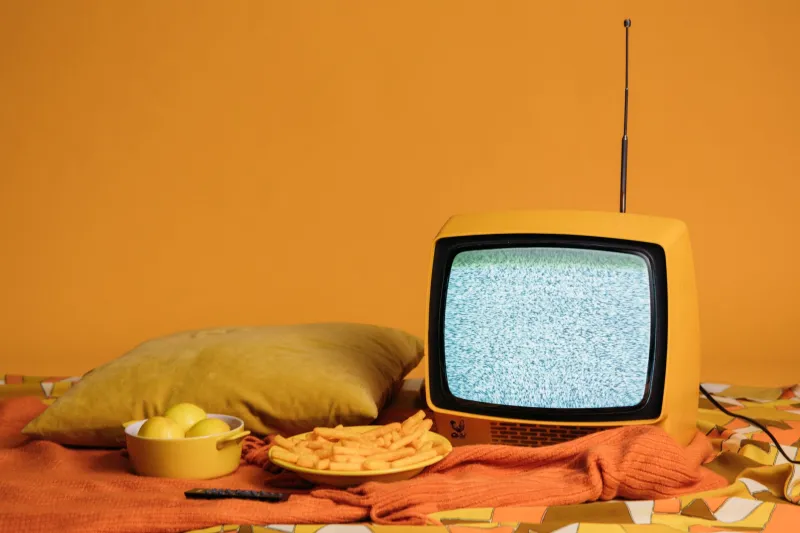
Put the Phone in the Kitchen: A One-Week Experiment for Shows That Actually Stick

Photo: John Benson, CC BY 2.0, via Wikimedia Commons
Last month I watched six episodes of a well-reviewed drama and could not name a single character. Not the lead. Not the lead's sister. Not the dog.
The show wasn't bad. I was. I had my phone in my hand the entire time — thumb on the glass, eyes flicking down every forty seconds to check a group chat about a youth soccer schedule. The show was on. I was not.
That's the thing nobody tells you about the “nothing sticks” feeling that sends so many of us hunting for a new series every three weeks. A lot of the time, the problem isn't the library. It's that we've quietly downgraded television to background noise and then wondered why nothing lands.
The Half-Watch Is the Default Now
Look around any living room in America at 8:30 p.m. — or honestly, look at your own couch. The TV is on. The laptop might be open. The phone is definitely out, and it isn't doing anything urgent. It's just there, offering a slot machine of tiny dopamine hits that don't require you to follow a plot.
We've built a habit where the show is the ambient layer and the phone is the main event. Then we blame the streaming services for making forgettable shows.
Why Split Attention Makes Good TV Feel Forgettable
Here's the mechanics of it, stripped of jargon. Memory doesn't record everything that happens in front of your face; it records what you paid attention to. If you're reading a text during the scene where two characters finally say the thing they've been not-saying for four episodes, that scene gets filed as background. You didn't experience the payoff. You experienced the room the payoff happened in.
So what do you do three episodes later, when the show is building on beats you skimmed? You get restless. You check the runtime. You decide it's slow. And because you're already scrolling, you start browsing for something else — something better — which is how you end up three apps deep with nothing playing at 11 p.m., vaguely annoyed at television as a medium.
There's a second-order effect too, one that hits your wallet. If every show feels like interchangeable background, no show is worth a subscription. You cancel one service, sign up for another, sample six pilots at half attention, and repeat. The churn isn't a taste problem. It's an attention problem wearing a taste problem's clothes.
What This Isn't
This is not a phone addiction lecture. I'm not going to tell you to delete Instagram or buy a wooden puzzle. Your phone is fine. Scrolling is fine. You can scroll for two hours after the episode ends and I won't say a word.
The ask is narrower: give the show the 47 minutes you already agreed to give it. That's the whole experiment.
The Setup: Seven Nights, One Rule
One rule, no exceptions: the phone leaves the room before the episode starts. Not face-down on the armrest. Not in your pocket. In another room — kitchen counter, bathroom, bedroom, wherever the Wi-Fi reaches and your arm doesn't.
A few ground rules to keep it honest:
- One episode per night. Not two. Two is how you turn an experiment into a binge and learn nothing.
- If you get the itch, you're allowed to pause. Stand up, walk to the phone, scroll, come back. Pausing isn't cheating. Silent half-watching is.
- Keep a note — paper beats another screen — with one line per night: the episode, and whether you could describe what happened the next morning.
That's the entire protocol. It costs nothing and requires no app.
The Before and After
The before is what you'd expect: episodes blurring together, a vague sense that the show was “fine,” and a browser tab with six other series queued as insurance in case this one didn't work out.
The after is stranger than I expected.
Nights one and two felt almost uncomfortable. Without the phone, the pacing seemed slow, and I noticed how often my hand drifted toward a pocket that had nothing in it. That's the withdrawal talking, and it passes faster than you'd think.
By night three, the show got better. Not objectively — it didn't change — but I could hear the dialogue, catch the jokes, and remember who was mad at whom. By night five I was thinking about the next episode during the day, which is the actual definition of being into something.
The side effects were the interesting part. I stopped needing a backup show. My watchlist stopped growing. And on night six I realized I didn't like a different series I'd been “watching” for three weeks — which sounds like a loss, but it freed up a whole evening and removed one more reason to keep a subscription around. That's a win.
Where It Gets Hard
Night two is the wall. The phantom reach is real, and the urge to check “just one thing” shows up right around the first act break, like it's been cued.
Two pieces of practical advice. First, put the phone somewhere annoying — a charger in a hallway beats a drawer next to the couch, because laziness is your ally. Second, remember that boredom is information. If you genuinely cannot get through 45 minutes without a screen in your hand, that's worth knowing, and it isn't a character flaw. It's a habit with a shape, and shapes can be changed.
One more: if you're watching with a partner or a roommate, agree on the rule together. One person scrolling while the other is invested is how you end up with two people irritated at each other and neither one following the plot.
If You Fall Off
You will, eventually. The dog needs letting out, or someone texts about tomorrow's carpool, and the phone migrates back to the couch. Fine.
Fall back to a smaller version: one episode, Do Not Disturb on, phone on the counter across the room. Not perfect. Still enough to change what your brain does with those 47 minutes.
The Takeaway
Turning a show on is easy. Nearly everything in the streaming stack is engineered to make it easier. Turning the rest of the world off for one episode is the part that takes a decision — and it turns out that decision is worth about as much as the subscription itself. Watch on purpose. Scroll on purpose. Both are better when they aren't happening at the same time.